

For centuries, humanity pictured the cosmos as a vast, silent void. We imagined stars and planets suspended within an infinite emptiness, separated by immense distances and governed by rigid, deterministic laws. Reality appeared binary. A switch was either on or off. A charge was either positive or negative. Space was either occupied by matter or completely empty.
Modern physics has fundamentally changed that picture.
Quantum field theory has revealed that the vacuum of space is anything but empty. What appears to be a void is, in fact, a dynamic ocean of quantum fields permeating every point in the universe. These fields continuously fluctuate, giving rise to measurable phenomena such as vacuum fluctuations, virtual particles, and the Casimir Effect. Far from being empty, the vacuum possesses structure, energy, and activity.
Recognizing that the vacuum has an underlying architecture forces us to reconsider the nature of everything embedded within it.
Physicists increasingly describe the universe not as a collection of isolated objects, but as a network of continuous, invisible fields whose interactions give rise to the particles and forces we observe. Matter itself is understood as localized excitations within these deeper quantum fields.
A similar lesson emerges from plasma physics.
Plasma, the fourth state of matter, demerges remarkable self-organizing behavior under electromagnetic forces. On the surface of our Sun, magnetic fields shape plasma into enormous filaments, twisting vortices, double layers, and intricate structures spanning thousands of kilometers. Despite the extreme energy involved, these formations remain surprisingly stable.
Their stability arises through resonance.
Standing waves and harmonic interactions organize what would otherwise be chaotic motion into persistent, coherent structures.
Today, science can map quantum fields, photograph plasma dynamics, and precisely measure resonant phenomena. Yet one profound challenge remains.
The microscopic rules governing quantum mechanics refuse to fully reconcile with the large-scale behavior of gravity and cosmic structure described by General Relativity. Despite decades of research, modern physics still lacks a universally accepted mathematical framework that seamlessly unifies the quantum and the cosmic.
This unresolved gap motivates new theoretical exploration.
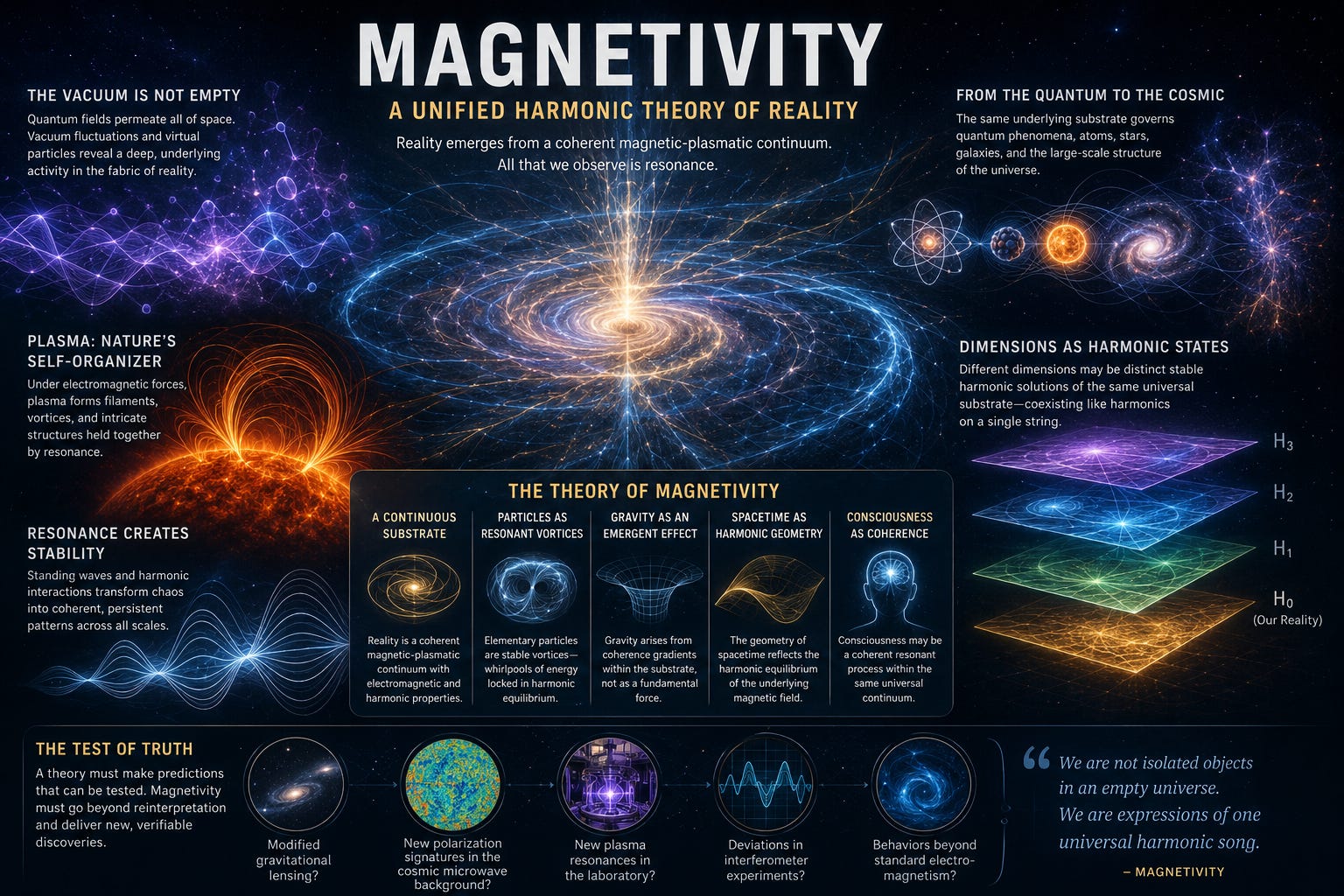
The Magnetivity Hypothesis
The Theory of Magnetivity proposes that reality emerges from a coherent magnetic-plasmatic continuum, a universal substrate possessing both electromagnetic and harmonic properties.
Rather than viewing particles as isolated objects moving through empty space, Magnetivity suggests that everything arises from continuous patterns of resonance within this underlying field.
Instead of relying on rigid binary opposites such as one versus zero, the theory envisions reality as a continuous spectrum of coherent probability.
This concept bears an interesting philosophical resemblance to quantum computing.
Unlike classical bits, which exist only as zero or one, quantum bits, or qubits, exist in superpositions, simultaneously representing multiple states until measurement. Magnetivity proposes that this continuous magnetic-plasmatic substrate may provide a physical medium through which such coherent quantum behavior naturally emerges. This is a speculative extension rather than an established interpretation of quantum mechanics.
Within this framework, quantum entanglement also receives a different interpretation.
Rather than viewing entangled particles as isolated objects connected through mysterious nonlocal correlations, Magnetivity proposes that they remain embedded within the same continuous harmonic substrate. The theory hypothesizes that this shared medium could provide a physical mechanism underlying quantum coherence. Importantly, this proposal does not imply faster-than-light communication, which would conflict with current experimental evidence and relativity. Instead, it suggests an alternative conceptual picture for understanding correlated quantum systems.
If such a universal harmonic field exists, it may also influence the stability of highly coherent quantum systems.
This raises an intriguing possibility.
Could a coherent magnetic-plasmatic substrate naturally suppress environmental decoherence? Could it stabilize qubits or reduce computational errors within quantum computers?
These questions remain speculative but illustrate how Magnetivity extends beyond cosmology into emerging technologies.
From Quantum Particles to Galaxies
A truly unified theory must explain reality across every scale.
Magnetivity therefore extends its framework from subatomic physics to the largest structures in the universe.
Elementary particles are no longer viewed as tiny, isolated billiard balls.
Instead, they become stable resonant vortices, persistent whirlpools of energy maintained through harmonic equilibrium within the universal substrate.
Atoms become coherent resonant structures.
Matter becomes organized resonance.
Galaxies become large-scale harmonic systems.
Even gravity receives a radical reinterpretation.
Rather than treating gravity as a fundamental force acting between masses, Magnetivity proposes that gravity emerges from coherence gradients within the magnetic-plasmatic continuum itself. Regions of differing harmonic density naturally produce the effects we interpret as gravitational attraction.
Likewise, spacetime is no longer viewed as an independent geometric stage upon which physics unfolds.
Instead, geometry itself becomes an emergent consequence of harmonic equilibrium within the underlying field.
In this way, Magnetivity seeks to provide a single organizing principle capable of connecting quantum uncertainty with planetary motion, plasma dynamics, and cosmic structure.
Standing on the Shoulders of Giants
Although Magnetivity presents a novel framework, it draws inspiration from a long tradition of scientific exploration.
Albert Einstein devoted decades to developing a unified field theory capable of merging gravity and electromagnetism.
Nikola Tesla frequently emphasized the importance of vibration and resonance in understanding nature, although many quotations attributed to him have been simplified or inaccurately repeated over time.
David Bohm envisioned an Implicate Order, a deeper interconnected reality from which our observable universe unfolds.
Other proposals, including Superfluid Vacuum Theory and Plasma Cosmology, have likewise explored the possibility that space itself behaves as an active medium.
Magnetivity shares conceptual similarities with these ideas while proposing a distinct harmonic magnetic-plasmatic substrate as the organizing foundation of reality.
The Ultimate Test
Scientific elegance alone is never enough.
History reminds us that beautiful theories can still be wrong.
For Magnetivity to evolve from an intriguing conceptual framework into an accepted scientific theory, it must make predictions that existing models do not.
For example:
Can it mathematically predict measurable deviations in gravitational lensing?
Can it identify previously undetected polarization signatures within the Cosmic Microwave Background?
Can it predict new resonant plasma behaviors beyond those described by conventional electromagnetism?
Can it explain astrophysical observations more accurately than existing cosmological models?
Can it generate experimentally verifiable equations that recover both Maxwell’s Equations and Einstein’s Field Equations under known conditions while extending beyond them?
These are the questions that determine whether Magnetivity ultimately succeeds or fails.
Without experimental confirmation, it remains an elegant hypothesis.
With experimental confirmation, it could fundamentally reshape our understanding of reality.
A New Vision of the Cosmos
Whether Magnetivity ultimately proves correct remains unknown.
Its significance lies not in claiming to possess all the answers, but in asking a profoundly different question.
What if matter is not fundamental?
What if gravity is not fundamental?
What if spacetime itself is not fundamental?
What if the universe is not built from isolated particles moving through empty space...
but from an infinite harmonic continuum whose resonant patterns give rise to every particle, every galaxy, every thought, and every conscious observer?
If so, reality may not be a collection of disconnected objects at all.
It may be a symphony.
And everything that exists, including ourselves, may simply be one coherent expression of its eternal song.


