

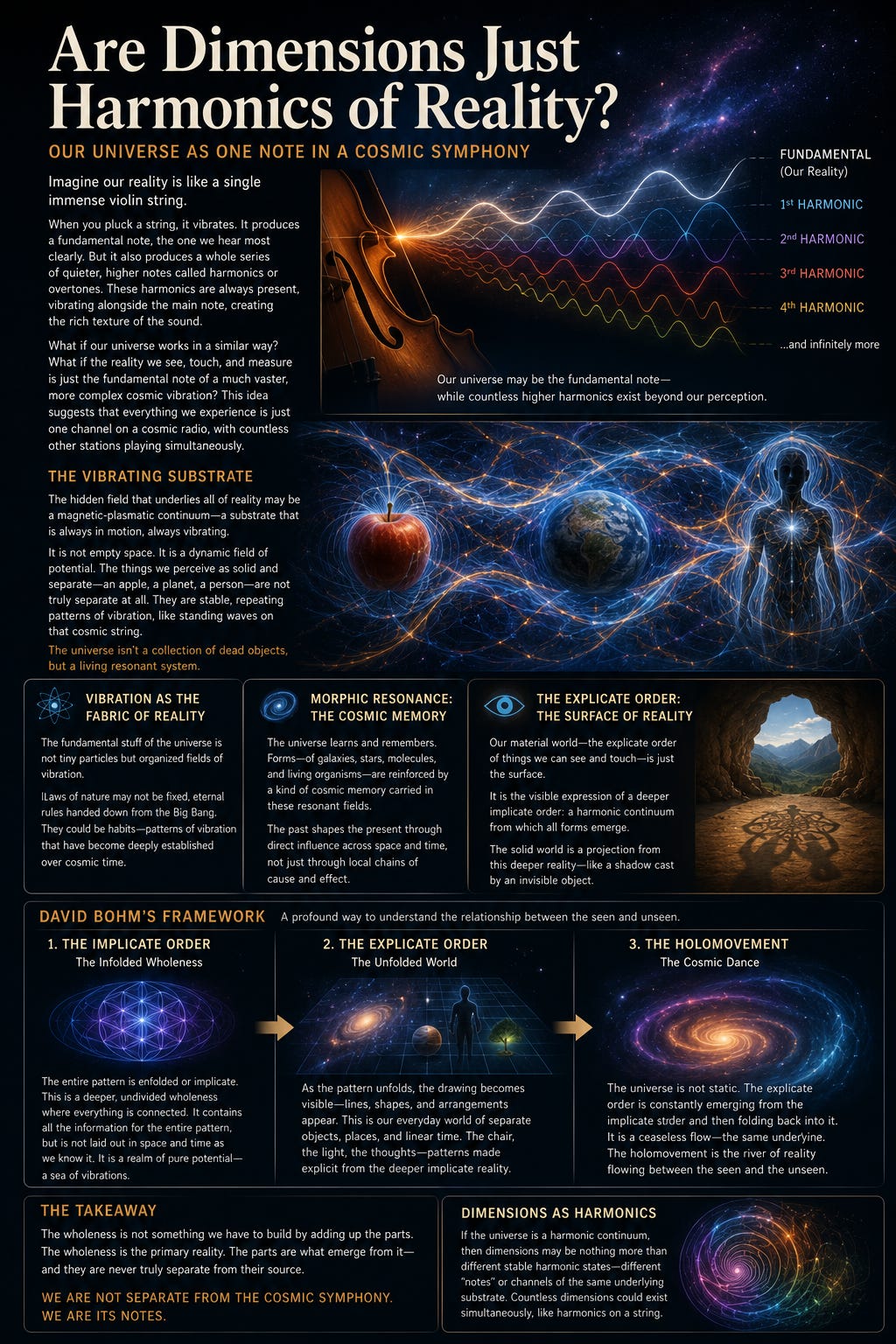
Imagine plucking a single violin string.
The instant your finger releases the string, it begins to vibrate. Most people hear only the dominant note, the fundamental frequency. But hidden within that sound is something far richer. The string simultaneously produces an entire family of quieter frequencies known as harmonics, or overtones. These harmonics are not separate strings. They are different resonant expressions of the very same string, existing simultaneously and combining to create the instrument’s rich, complex voice.
Now imagine that reality itself works the same way.
What if the universe we experience, the one we see, touch, and measure, is merely the fundamental harmonic of an unimaginably larger cosmic vibration? What if countless other harmonic states exist simultaneously, not as distant places in space, but as different resonant expressions of the same underlying reality?
This possibility invites a profound question:
Are dimensions simply harmonics of reality?
Beyond Empty Space
For centuries, physics treated space as little more than an empty stage upon which matter performed.
Modern physics paints a far different picture.
Quantum field theory tells us that the vacuum of space is anything but empty. Invisible quantum fields permeate every point in the universe. Even in complete darkness, the vacuum continually fluctuates with measurable activity. Particles emerge as excitations of these underlying fields, while phenomena such as the Casimir Effect demonstrate that the vacuum itself possesses measurable physical properties.
Likewise, plasma physics reveals another remarkable truth.
Plasma, the fourth state of matter, naturally organizes itself into extraordinary structures under electromagnetic forces. Filaments, vortices, double layers, and coherent plasma formations emerge throughout the universe, from laboratory experiments to the surface of the Sun.
Resonance creates order.
Standing waves generate stability.
Coherence produces structure.
These principles are well established within modern physics.
The question is whether they represent isolated phenomena, or clues pointing toward something even deeper.
A Harmonic Continuum
One emerging philosophical interpretation is that beneath everything lies a continuously vibrating substrate, a coherent magnetic-plasmatic continuum from which all observable reality emerges.
In this view, space itself is not empty.
It is a living harmonic medium.
The objects we perceive as separate, a planet, a tree, an atom, or a human being, are not independent entities drifting through empty space. Instead, they are stable standing waves within this deeper continuum. Like notes sustained on a violin string, they persist because resonance continually reinforces their structure.
Matter becomes organized vibration.
Particles become resonant vortices.
Atoms become long-lived harmonic attractors.
Reality itself becomes an ongoing process of coherent resonance rather than a static collection of isolated objects.
A Universe That Learns
This perspective also invites another intriguing possibility.
Perhaps the laws of nature are not merely fixed rules imposed upon the universe since the Big Bang.
Perhaps they are stable habits of resonance.
This idea resembles the hypothesis of morphic resonance proposed by Rupert Sheldrake, which suggests that patterns in nature become reinforced through repetition over time. Although morphic resonance remains controversial and has not gained broad acceptance within mainstream science, it raises an interesting philosophical question: could the universe possess a kind of structural memory?
Within a harmonic framework, galaxies, stars, molecules, and biological systems might represent resonant configurations that have become increasingly stable through cosmic evolution.
Reality would not simply exist.
It would continuously organize itself.
Bohm’s Hidden Reality
A similar vision emerged from the work of theoretical physicist David Bohm.
Bohm proposed that our familiar world represents only one aspect of reality.
He described two complementary orders.
The Explicate Order is the observable universe, the world of separate objects, measurable distances, and linear time.
Beneath it lies the Implicate Order, a deeper, enfolded level of reality where everything remains fundamentally interconnected.
Imagine an intricate drawing folded inside a sheet of paper.
While folded, the complete image exists but remains hidden.
As the paper unfolds, portions of the drawing become visible.
For Bohm, our universe resembles that unfolding process.
The visible world emerges continuously from a deeper, unified foundation.
He called the ongoing process connecting these two realities the Holomovement—the endless unfolding and enfolding of existence itself.
Nothing is truly static.
Everything is process.
Everything flows.
Dimensions as Harmonic States
Now consider one final step.
If reality is fundamentally harmonic...
perhaps dimensions are not additional directions in space.
Perhaps they are stable harmonic states within the same universal continuum.
Just as a violin string supports multiple harmonics simultaneously, the underlying fabric of reality may support multiple coherent solutions at once.
Each harmonic state would possess its own geometry.
Its own relationships.
Its own expression of matter.
Its own spacetime.
From this perspective, dimensions are not separate universes disconnected from our own.
They are different resonant modes of the same underlying field.
Our observable universe would simply be one stable harmonic among many possible harmonics.
From Philosophy to Physics
This idea is undeniably elegant.
It connects resonance, quantum fields, plasma organization, gravity, geometry, and consciousness through a single organizing principle.
But elegance alone does not establish scientific truth.
At present, the concept of dimensions as harmonic states remains a philosophical and theoretical proposal rather than an accepted physical theory.
For such an idea to become science, it must do what every successful scientific theory has done before it.
It must become mathematical.
It must generate unique predictions.
It must survive experimental testing.
Could it predict previously unknown gravitational phenomena?
Could it reveal new plasma behaviors?
Could it explain quantum coherence more completely than existing models?
Could it identify measurable signatures within the Cosmic Microwave Background or other astrophysical observations?
Only careful experimentation can answer these questions.
Listening to the Symphony
Whether dimensions ultimately prove to be harmonic states or not, the idea invites us to reconsider one of our deepest assumptions.
Perhaps the universe is not fundamentally built from isolated particles moving through empty space.
Perhaps it is built from resonance.
Perhaps space is not a void but a living continuum.
Perhaps matter is simply music made visible.
And perhaps what we call reality is only the first, loudest note in an infinite cosmic symphony whose higher harmonics have yet to be heard.
If that is true, then dimensions are not distant places waiting to be discovered.
They are already here, vibrating silently alongside our own, waiting for us to understand the deeper harmony from which all realities emerge.


